
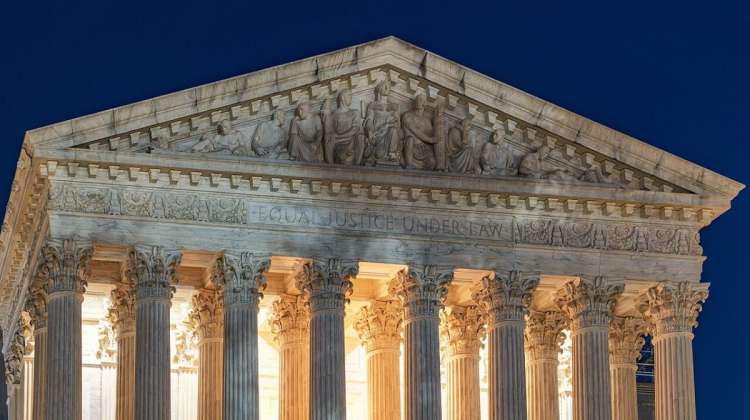
Supreme Court cuts deep into 60-year voting rights law
The stakes were unmistakable when Lyndon B. Johnson prepared to sign what would become one of the most defining laws in American democracy. He understood the political risk many lawmakers had taken to get it passed, some at the cost of their own careers. Instead of hosting the moment behind closed doors, he carried it to Capitol Hill on August 6, 1965, marking the occasion in full public view. The signing came just months after the Selma to Montgomery marches, where the violence of “Bloody Sunday” helped push the legislation into reality.
Over the decades that followed, the Voting Rights Act of 1965 reshaped the political landscape. It curbed discriminatory voting practices and opened doors for thousands of Black and Hispanic candidates to win office across the country.
Now, that legacy faces renewed uncertainty.
READ ALSO: Appeals court blocks Trump no-bond detention policy, sets up Supreme Court clash
On Wednesday, the Supreme Court of the United States struck down a central safeguard of the law, weakening protections against racial discrimination in elections and representation. The ruling builds on earlier decisions that had already chipped away at the statute, including a major blow more than a decade ago. Advocates warn the latest move could accelerate efforts that sideline minority voters.
“It means that you have entire communities that can go without having representation,” said Cliff Albright, a co-founder of Black Voters Matter. “It is literally throwing us back to the Jim Crow era unapologetically, and that’s not exaggeration.”
Kareem Crayton of the Brennan Center for Justice said the court’s direction has been unmistakable. He described the cumulative effect of its rulings as “burying it without the funeral.”
The latest decision stems from a Louisiana redistricting dispute. Lawmakers had drawn a congressional map that resulted in a second Black-majority district, increasing Black representation in Washington. The court, however, ruled that the map crossed constitutional lines by factoring race into how boundaries were set. Writing for the majority, Samuel Alito argued that Section 2 of the law was meant to address intentional discrimination, not outcomes shaped by race-conscious districting.
In dissent, Elena Kagan warned that requiring proof of deliberate bias creates a near-impossible standard. She said the threshold is “an almost insurmountable barrier for challenges to any voting rights issues to prove discrimination.”
Legal analysts say the impact could be far-reaching. Without robust enforcement of Section 2, they argue, the Voting Rights Act risks becoming largely symbolic, leaving room for mapmakers from local school boards to Congress to redraw districts in ways that weaken minority influence.
READ ALSO: Trump charts new path on import taxes after Supreme Court blocks key tariffs
“We’re witnessing the evisceration of America’s greatest legislative landmark at the hands of a far right Supreme Court,” said Ritchie Torres in an AP report.
Maria Teresa Kumar said the ruling will likely intensify tactics known as “cracking and packing,” where voting blocs are split or concentrated to dilute their power. “Not just in congressional districts but also in state legislatures, county commissions, school boards and city councils.”
The court’s approach echoes its 2013 decision in Shelby County v. Holder, which dismantled the preclearance system that once required certain states to obtain federal approval before changing voting laws. That ruling opened the door to a wave of tighter election rules, particularly in Republican-led states. The trend intensified after Donald Trump falsely claimed widespread fraud in the 2020 election won by Joe Biden.
There had been a brief counterpoint in 2023, when the court upheld Section 2 in an Alabama case, preserving protections that led to the creation of a new Black-majority district. The latest ruling effectively reverses that direction.
The consequences are already being felt. In Louisiana, Representative Cleo Fields now faces an uncertain political future as district lines are expected to shift again. He has seen this scenario before. “I’ve been down this road before, you know, 33 years ago,” he said.
In Alabama, Shomari Figures noted that while current districts remain intact, the legal path for future challenges has narrowed considerably. “It will lead to states, primarily in the South, launching immediate efforts to redraw districts in ways that will dilute the impact of Black voters and drastically reduce the number of realistic opportunities to elect Black members to Congress,” he said.
READ ALSO: U.S. opens refund path after Supreme Court strikes down Trump tariffs
Among residents like Shalela Dowdy, who helped secure the district change in 2023, the concern is more immediate. She fears the progress made could be undone. “Putting it in the hands of the states on this level is dangerous,” Dowdy said. “There’s just been a history of the states not doing the right thing based off their state population.”
