
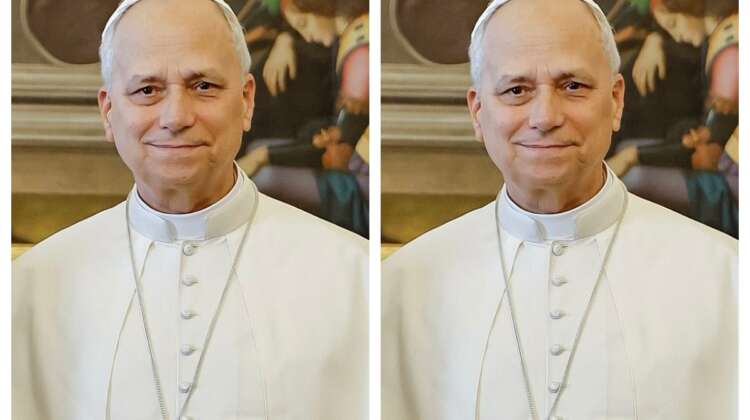
Pope Leo XIV stresses peace as Trump’s attacks intensify
With criticism from Donald Trump still escalating, Pope Leo XIV used a midweek stopover to restate what he believes should dominate global discourse right now, peace over provocation, dialogue over division.
Speaking briefly to reporters while traveling to Cameroon as part of his African tour, Leo avoided any direct reference to Trump’s latest remarks or the warning issued by JD Vance urging caution in theological commentary. He did not entertain questions, instead steering attention toward the deeper themes shaping his visit.
His reflections circled back to Annaba, historically known as Hippo, where Augustine of Hippo served as bishop. The pope described the visit as more than symbolic, presenting it as a reminder of enduring spiritual inquiry and the search for truth.
READ ALSO: Vatican visitors defend Pope Leo XIV, blast Trump’s “absurd” remarks
“His writings, his teaching, his spirituality, his invitation to search for God and to search for truth is something that is very much needed today, a message that is very real for all of us today as believers in Jesus Christ, but for all people,” Leo said, according to a report by the AP.
Without naming his critics, Leo’s remarks carried a subtle response to the backlash from the Trump administration over his condemnation of the Iran war. He has previously argued that divine blessing cannot be invoked for acts of destruction and described Trump’s threat to wipe out Iranian civilization as “truly unacceptable.”
Trump, undeterred, has continued his online attacks, accusing the U.S.-born pontiff of weakness and political bias while even claiming credit for his rise to the papacy. One controversial post featuring an AI-generated, Christ-like image of Trump sparked backlash, including from some of his own supporters.
The tension sharpened overnight when Trump reacted to resurfaced pre-papal posts by Leo, writing “Not good!!!” before adding: “Will someone please tell Pope Leo that Iran has killed at least 42,000 innocent, completely unarmed, protesters in the last two months, and that for Iran to have a Nuclear Bomb is absolutely unacceptable.”
Back in Algeria, Leo leaned on the legacy of Augustine to emphasize coexistence. He pointed out that although the country is overwhelmingly Muslim, its people continue to revere the theologian as a shared historical figure, a reality he said offers a foundation for mutual respect.
By retracing Augustine’s steps, the pope explained, he hoped to project a vision rooted in unity rather than difference.
“unity among all peoples and respect for all people in spite of the differences.”
READ ALSO: Vance tells Pope Leo to stay out of U.S. policy amid Trump clash
That same message carried into his visit to the Great Mosque of Algiers, where he paused in silent prayer, presenting the moment as a quiet but powerful statement about coexistence.
“I think the visit to the mosque was significant to say that although we have different beliefs, we have different ways of worshiping, we have different ways of living, we can live together in peace,” he said.
“And so I think that to promote that kind of image is something which the world needs to hear today.”
Despite the ongoing criticism from Trump, Leo highlighted the reception he received in Algeria, noting the rare gesture of a full military airborne escort into the country’s airspace during what marked the first papal visit there.
“It’s a sign of the goodness, of the generosity, of the respect that the Algerian people and the Algerian government have wished to show to the Holy See and to myself,” Leo said.
Inside the Vatican, the pushback has been more explicit. Editorial director Andrea Tornielli directly challenged Vance’s invocation of the “just war” doctrine, arguing that its historical foundations no longer align with the realities of modern combat.
He noted that the concept emerged in an era of swords and limited warfare, not one shaped by drones and precision-guided weapons.
“This teaching has gradually been enriched and deepened, to the point of recognizing how increasingly difficult it is to claim that a ‘just war’ exists,” Tornielli wrote on Vatican Media. Modern warfare poses a “reality that raises moral questions of dramatic intensity.”
“There has been a growing awareness that war is not a path to be followed,” he wrote.
READ ALSO: Trump refuses to apologize as Pope Leo feud intensifies over meme and Iran war
In Washington, Robert McElroy, the archbishop, has also weighed in, arguing that the U.S.-Israeli campaign against Iran failed to meet even the baseline moral thresholds traditionally required to justify war, including the presence of an imminent threat and a clear balance of benefit over harm.
