
New find at Thomas Jefferson’s Monticello largely built by enslaved workers shows the property still holds secrets
For many years now, archaeologists have been studying Monticello, the 18th-century plantation and home of Thomas Jefferson. They, however, keep making new finds. Not too long ago, researchers unearthed the remains of a kiln buried under the property’s East Lawn.
They believe the structure dates back to the early 1770s, ahead of his Declaration of Independence in 1776. They also think that it was used to fire and cure bricks that were used in the construction of Monticello I, the first version of Jefferson’s home, in the early 1770s.
Jefferson inherited the mountaintop plot in Virginia from his father in 1764, according to the Smithsonian. A founding father and the nation’s third president, Jefferson began preparations for a house at Monticello in the late 1760s. Workers, including enslaved men and women, built the two-story, three-room home, currently known as Monticello I, in the 1770s. The current structure of the house is an expansion that was completed by 1789.
Monticello’s archaeological field research manager, Crystal O’Connor, and director of archaeology Fraser Neiman announced the latest discovery at the site on March 30.
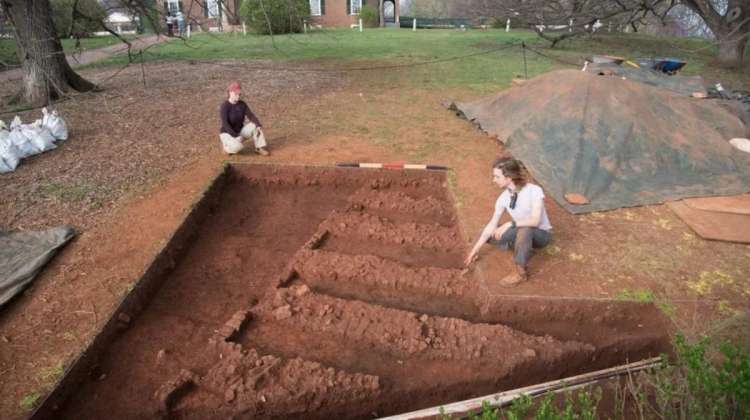
O’Connor said the kiln was a large, temporary oven used to harden bricks. Speaking with Fox News Digital, she noted that archaeologists found brick channels “filled with overcooked brick rubble, and the soil beneath them had been baked hard by intense heat.”
She said archaeologists “immediately started hitting brick, and uncovered a series of low parallel brick walls, evenly spaced about a foot and a half apart, with channels running between them.”
“While the team and I weren’t sure of what we were looking at initially, that pattern is a telltale sign of a brick kiln,” O’Connor added.
Researchers believe that workers piled thousands of unfired bricks atop the kiln and kept fires burning for several days until the bricks hardened.
“When the firing was done, workers took the kiln apart and carried the finished bricks to the house,” O’Connor said, adding that “This kiln was crucial to building the home of the author of the Declaration of Independence.”
O’Connor said the kiln may have been operated by George Dudley or William Bishop, two White workmen who were hired by Jefferson, adding that the structure relied heavily on enslaved labor. More than 600 people were enslaved by Jefferson, historians have said.
“Jefferson knew about this work because he contracted with his brickmakers for a set number of bricks before each major building campaign,” O’Connor said. “He would not have overseen the firings himself. Dudley or Bishop would have managed that process.”
She said Jefferson examined whether it was better to haul finished bricks uphill or make them on site in late 1774.
“We wonder if the brickmakers themselves pointed out the problem of dragging barrels of water and loads of firewood uphill, and if that helped push Jefferson to do the math and move the work downhill, closer to the raw materials,” she added.
Monticello, a popular tourist attraction that brings in about 500,000 visitors each year, is a UNESCO World Heritage Site.
Archaeologists, including students from the University of Virginia, still investigate the site. O’Connor shared how important archaeology is at Monticello, largely due to the fact that the kiln was not recorded in Jefferson’s maps, drawings, notes and letters.
“The discovery has already changed how we understand the building of Monticello,” she said.
“Even at one of the best-documented historic sites in America, archaeology keeps revealing what the written record does not.”
