
‘All souls of the Ashanti are within it’: The mystery of the Ashanti Kingdom bowl believed to be from 1500s Europe
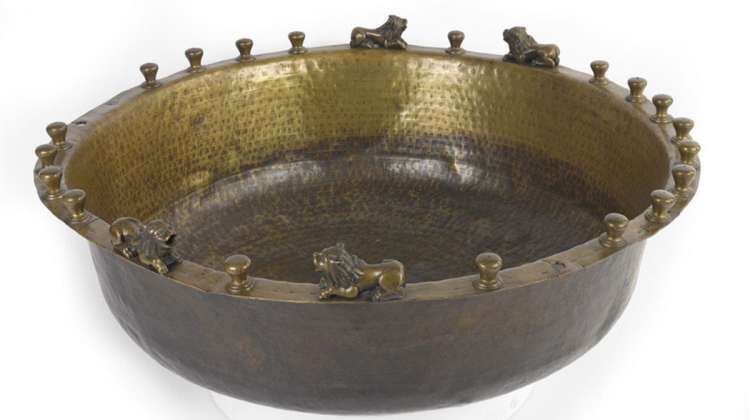
On show at the British Museum in a display titled The Asante Ewer is the “Aya Kese”, believed to have been made in Europe, taken to the Asante Kingdom of Ghana, looted by British troops in the late 19th century, and now in a UK museum.
It remains unclear exactly where the huge northern European brass basin decorated with lion figures was made and how it reached the Asante Kingdom in West Africa centuries ago.
Now on temporary display at the British Museum but owned by London’s National Army Museum, the basin is believed by British Museum curators to have been made in England, the Netherlands, or Germany and likely dates from the 16th century.
By the early 18th century, the brass basin had reached the Asante Kingdom, where it ended up as a sacred object in the royal mausoleum complex. The basin, just over a metre in diameter, had been used to hold the blood of human sacrifices, some Europeans believe. However, this claim has been questioned by scholars in recent years.
According to the Art Newspaper, the Asante king, Prempeh I, wrote in 1930 that the “Aya Kese” had originally descended from heaven on a gold chain, following a massive thunderstorm. But most historians say that the basin probably arrived there on a trading ship that sailed from northern Europe or Portugal around the coast of West Africa.
What is most striking about the Aya Kese is the four small sculpted lions on the edge of it. “These beasts were used in European decorative art over many centuries, so an examination of the sculptures has so far not helped in dating or establishing where they were made,” the Art Newspaper wrote.
In 1817, Thomas Bowditch, a British man, visited the Asante Kingdom’s capital of Kumasi, where he saw the “Aya Kese” in the royal mausoleum complex located at Bantama, near the city. He wrote about “the largest brass pan I ever saw (for sacrifices), being about five feet in diameter, with four small lions on the edge,” according to the Art Newspaper. Bowditch further stated that “human sacrifices are frequent and ordinary, to water the graves of the kings”.
Decades later, when British troops invaded the Asante Kingdom in 1896, Robert Baden-Powell took the “Aya Kese” before the Bantama mausoleum was set ablaze.
“We set the whole of the fetish village in flames, and a splendid blaze it made,” Baden-Powell is later reported to have said after the military operation.
Upon his return to England, Baden-Powell, who would later found the Boy Scouts, kept the sacred basin until 1913, when he donated it to the Royal United Services Institute, which studies defence and security. In 1963, the center also gave the basin to the National Army Museum, where it is now being kept.
In 2021, the basin was taken off show at the Museum as permanent collection displays were being refreshed. The Art Newspaper reports that after it returns from the British Museum, where it is on show until June 7, the Aya Kese will be sent back to the National Army Museum’s storage facility. After, “we will consider its display as part of our wider interpretation plans,” a museum spokesperson told the outlet.
In case of any loan request, probably from Ghana, the Museum said it would consider it under its normal lending policy.
In 1930, Prempeh I formally wrote to British authorities, asking for the return of the basin to the royal mausoleum. In a five-page “History of the Bantama Brass Pan”, the king wrote that “all souls of Ashantis are within it”. He also stressed that “the allegation that human beings were killed in the brass pan is not a fact”. The British refused his request, and now, it remains unknown if the Asante king’s Manhyia Palace Museum in Kumasi might request its return, either through a loan or permanently.
Two years ago, the UK loaned back 32 pieces of Asante Gold, considered “crown jewels,” to Ghana, 150 years after they were taken. The artifacts, named after the Asante empire, were returned to the current King of Asante, Otumfo Osei Tutu II, on a three-year loan agreement, extendable for an additional three years, bypassing the Ghanaian government.
The items are being held by the Victoria & Albert Museum and the British Museum, according to the BBC. Museums, facing legal restrictions on returning contested items, are using historic loan deals, like the one with Asante Gold, to facilitate returns to their countries of origin. However, some nations may hesitate, as it could inadvertently affirm Britain’s ownership of the items.
The Asante, or Ashanti, were a dominant people who governed a significant portion of present-day Ghana from the 1700s to the 1900s. The Asante Empire, known for its wealth from gold and agricultural trade, was also involved in slave trading. From 1824 to 1900, the empire engaged in five conflicts with the British Empire and its African allies, aiming to control the coastal areas of present-day Ghana.
While the Asante initially won some conflicts, British success in the fourth and fifth conflicts led to the annexation of the empire. The capital, Kumasi, was burned to the ground, and the city and royal palace were looted. Gold and other artifacts were either sold or given to Britain as reparations for the wars’ costs.
