
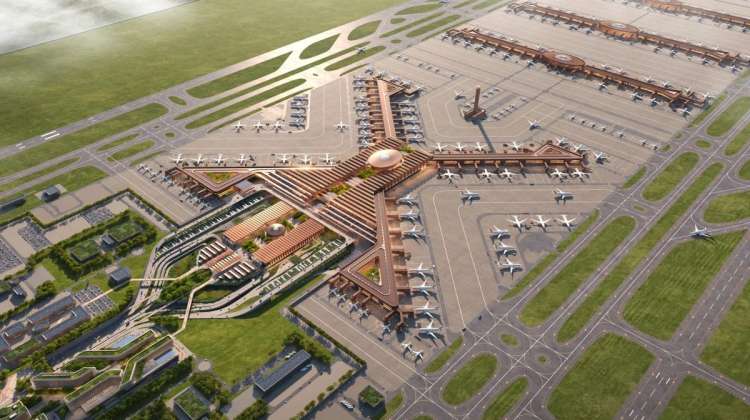
Ethiopia is building Africa’s biggest airport for $12.5 billion
Works have begun in Ethiopia on what is set to become Africa’s biggest airport, which will change the face of air travel across the continent.
Bishoftu International Airport, located about 30 miles southeast of Addis Ababa, is expected to open in 2030 with two runways and capacity for 60 million passengers a year, according to CNN. The plan is to expand that capacity to 110 million passengers, which would be more than the world’s busiest airport, Atlanta’s Hartsfield-Jackson, which recorded 106 million passengers in 2025. Further expansion works will also see the airport having four runways and parking for 270 aircraft.
The $12.5 billion airport project was announced by Ethiopian Prime Minister Abiy Ahmed, who described it as “the largest aviation infrastructure project in Africa’s history.”
State-owned Ethiopian Airlines, Africa’s largest carrier by fleet size, total passengers and revenue, is leading the project. CEO Mesfin Tasew told CNN the airline “will invest 30% of its equity” to cater to the $12.5 billion cost directly. The remaining $8 billion has not yet been covered, as international partners including the U.S., China and Italy are still involved in negotiations.
The airport seeks to find a solution to a decades-old problem in African aviation, where many travelers are forced to transit through cities outside the continent, such as London or Dubai, to get to other African destinations. As it aims to expand capacity, the Bishoftu project could boost regional travel, connectivity and support trade under the African Continental Free Trade Area.
Zaha Hadid Architects, known for large-scale, futuristic airport projects including Mumbai’s lotus-shaped airport, is the designer for the project.
The airport will give travelers “a feeling of what Ethiopia’s like” as the X-shaped terminal’s semi-enclosed spaces and courtyards are being designed with Bishoftu’s temperate climate in mind, ZHA’s director of aviation, Cristiano Ceccato, told CNN.
With the aviation industry accounting for 2–3% of global CO₂ emissions, sustainability is essential for this project, with developers using solar energy, locally sourced materials and a stormwater system, according to CNN.
The project has, however, been criticized by locals who say they have had to move to make way for the development. Over 15,000 people have reportedly been forced to move from over 9,000 acres of agricultural land.
Even though Ethiopian Airlines said it is investing $350 million in resettlement and infrastructure, providing homes with electricity, running water, schools and health care facilities, some residents have raised concerns about compensation or replacement housing.
Landry Signé, executive director at Arizona State University’s Thunderbird School of Global Management and senior fellow at the Brookings Institution, told CNN that any “unresolved community grievances” could cause the project to be delayed and ruin its chances of attracting more investment.
