
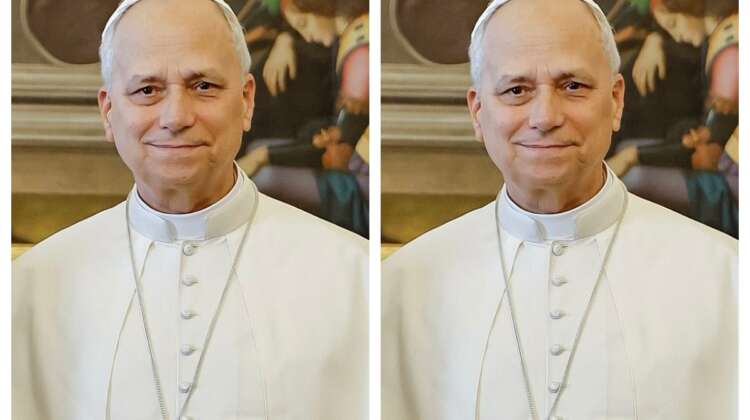
Pope Leo XIV lands in Equatorial Guinea, slams resource exploitation and power abuse
Pope Leo XIV touched down in Equatorial Guinea on Tuesday, closing out his multi-country tour of Africa with a pointed critique of how the continent’s natural wealth is being exploited and how power is wielded at the top.
His arrival sparked a wave of excitement in Malabo. Crowds packed the route from the airport, greeting him with cheers as he made his way through the capital, the AP reported. It marked the first papal visit to the country in more than four decades, since Pope John Paul II came through in 1982. Dressed in a red mozzetta and riding in an open-sided popemobile, Leo acknowledged the sea of flags and applause before heading to the presidential palace.
“There is a lot of joy today because we waited 44 years for the pope to come,” said Diosdado Marques, a senior Catholic official in the country. “It’s a blessing for the country. We hope many things will change and we will deepen our faith.”
READ ALSO: ‘Not in my interest’ – Pope Leo XIV rejects Trump debate, doubles down on Peace
The visit unfolds in a nation long shaped by one man’s rule. Teodoro Obiang Nguema Mbasogo, in power since 1979, presides over a state frequently criticised for repression and corruption. Oil discoveries in the 1990s turned Equatorial Guinea into one of Africa’s major producers, with petroleum now dominating exports and contributing heavily to national income. Despite that, poverty remains widespread, and watchdog groups say the benefits have largely stayed within the ruling circle.
After arriving from Angola, Leo met Obiang behind closed doors before addressing officials, diplomats and civil servants. His speech drew on the legacy of Pope Francis, noting the anniversary of his death and echoing his warnings about inequality driven by profit-focused global systems.
“Such an economy kills,” Leo said. “In fact, it is even more evident today than in years past that the proliferation of armed conflicts is often driven by the colonization of oil and mineral deposits, occurring with no regard for international law or the self-determination of peoples.”
His remarks land at a time of intensified global competition for Africa’s resources. The Trump administration has been pushing to secure access to critical minerals, positioning itself against China’s longstanding presence on the continent. Recent efforts have included involvement in negotiations tied to Congo’s conflict zones, as well as infrastructure investments like the Lobito Corridor rail project linking mineral-rich regions to Angola’s coast.
Talks and ceremonies during the visit were held in the old presidential palace. Meanwhile, the government is in the midst of shifting administrative functions to a newly constructed inland capital, Ciudad de la Paz. Officials describe the move as a long-term development strategy, but critics argue it risks deepening inequality and creating fresh avenues for elite enrichment.
Leo approached the issue obliquely, invoking Augustine of Hippo and his work City of God. Drawing a contrast between temporal ambition and spiritual purpose, he framed the country’s future as a choice between two paths.
“The earthly city is centered upon the proud love of self, on the lust for power and worldly glory that leads to destruction,” he said. “It is essential to discern the difference between that which lasts and that which passes, remaining free from the pursuit of unjust wealth and the illusion of dominion.”
READ ALSO: Half a million expected as Pope Leo XIV prepares for historic Cameroon mass
While he avoided directly naming corruption allegations or the controversies surrounding the new capital, the message was clear enough for those listening.
Equatorial Guinea remains officially secular, but Catholicism plays a central role in public life, with roughly three-quarters of the population identifying with the church. That closeness to power has drawn scrutiny.
Church leaders “are very much interconnected intrinsically with the government,” said Tutu Alicante, a U.S.-based activist who runs the EG Justice rights group. “Part of it is the fear the government has instilled in everyone, including the church, and part of it is the monetary gains that the church derives from this government.”
From within the Vatican, the balance is framed differently. The Rev. Fortunatus Nwachukwu argued that engagement, rather than confrontation, defines the church’s approach in politically sensitive environments.
“Should the church go to war against the government? Surely no,” Nwachukwu said. “Should the church swallow everything as if it were normal? No. The church has to continue preaching justice, always in defense of life, human dignity and the common good.”
Aside from governance concerns, the country has also come under scrutiny for its role in migrant relocation agreements. Deals with Washington have seen individuals deported from the United States sent to Equatorial Guinea despite having no ties there. Some have reportedly remained in detention in Malabo with limited access to legal and medical support, while others were later returned to places where they could face harm.
READ ALSO: Pope Leo XIV calls for ‘chains of corruption’ to be broken in Cameroon
Leo is expected to continue his visit with a stop at a prison in the coastal city of Bata. He has already been outspoken about U.S. deportation policies, describing them as “extremely disrespectful.”
