
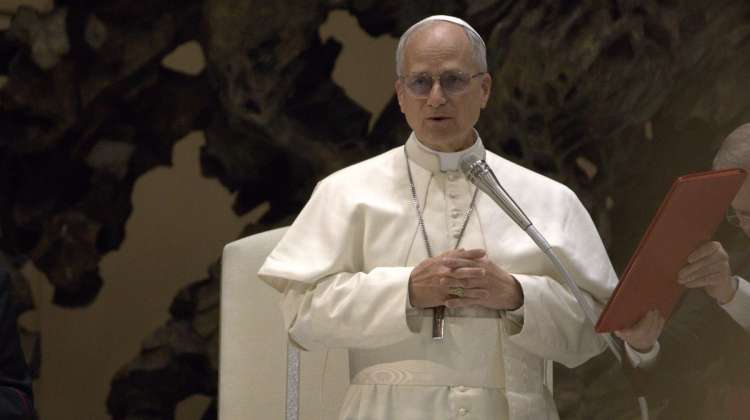
Pope Leo XIV uses Cameroon visit to call out “tyrants” profiting from conflict
Pope Leo XIV used his visit to Cameroon to deliver a forceful condemnation of global violence and exploitation, accusing a small group of “tyrants” of driving wars and plundering the world’s resources while calling for a decisive turn toward peace.
The pope’s arrival in the western Cameroonian city, Bamenda, turned into a street-wide celebration. Residents poured out in large numbers, dancing, honking horns and lining the roads, welcoming a visit many saw as long overdue recognition of their suffering.
At the center of his trip was a peace gathering that brought together religious and traditional leaders, including a Mankon chief, a Presbyterian moderator, an imam and a Catholic nun. The meeting underscored ongoing interfaith efforts aimed at ending the conflict and supporting those caught in it.
READ ALSO: Pope Leo XIV calls for ‘chains of corruption’ to be broken in Cameroon
Inside St. Joseph Cathedral, built on land donated by the Mankon community, Leo commended those efforts but cautioned against weaponizing faith. His remarks echoed concerns he has repeatedly raised in the context of global conflicts, including tensions tied to the U.S.-Israeli war in Iran.
“Blessed are the peacemakers!” he said. “But woe to those who manipulate religion and the very name of God for their own military, economic and political gain, dragging that which is sacred into darkness and filth.”
He urged a “decisive change of course,” calling for an end to both armed confrontation and the exploitation of natural resources for profit or power.
“The world is being ravaged by a handful of tyrants, yet it is held together by a multitude of supportive brothers and sisters!” he said, according to an AP report.
Although his message was rooted in Cameroon’s separatist crisis, Vatican officials indicated it was meant to resonate far beyond the country’s borders, addressing a wider pattern of conflict and extraction across the globe.
Leo went on to describe Bamenda as an example of resilience and unity, declaring: “Bamenda, today you are the city on the hill, resplendent in the eyes of all!”
It remained unclear whether separatist fighters, who had announced a temporary ceasefire to allow the visit, were present at any of the events.
The roots of the conflict trace back to colonial-era divisions following World War I, when Cameroon was split between British and French control. Although the English-speaking regions later joined the French-speaking majority in a 1961 U.N.-backed vote, grievances over marginalization have persisted for decades.
READ ALSO: Pope Leo XIV stresses peace as Trump’s attacks intensify
Armed separatism erupted in 2017, with fighters seeking independence from the Francophone-led government. According to the International Crisis Group, the conflict has claimed more than 6,000 lives and forced over 600,000 people from their homes.
Leo’s reception in Bamenda carried the energy of a festival, complete with music blasting from loudspeakers and crowds surging to catch a glimpse of him.
“We are so overjoyed, so overwhelmed,” said Felicity Cali, a Catholic student. “Say thank you, God, for this extraordinary day and for making us be alive to see this day.”
Later, addressing an estimated 20,000 worshippers at an airfield Mass, the pope expanded his critique to include both domestic governance and foreign economic interests. He pointed to “moral, social and political corruption” as a barrier to progress, then widened the lens further.
Added to these internal problems of conflict and corruption “is the damage caused from outside, by those who, in the name of profit, continue to lay their hands on the African continent to exploit and plunder it,” he said.
His remarks recalled the message delivered by Pope Francis during a 2023 visit to Congo, when he denounced external exploitation with the phrase “Hands off Africa!”
Investigations in the United States and Europe have suggested that elements of the separatist movement receive support from abroad. In December, a U.S. federal jury convicted two individuals of supplying funds and equipment to fighters, while Belgian authorities later arrested suspects linked to similar activities.
“Those who rob your land of its resources generally invest much of the profit in weapons, thus perpetuating an endless cycle of destabilization and death,” Leo said. “It is a world turned upside down, an exploitation of God’s creation that must be denounced and rejected by every honest conscience.”
Cameroon’s vast reserves of oil, gas and minerals have made it a focal point for international extraction, historically dominated by European firms but increasingly attracting Chinese investment, particularly in gold mining.
Despite a recent dip in large-scale attacks, the conflict remains unresolved. Negotiations have repeatedly broken down, with both sides accusing the other of insincerity.
For many residents, the pope’s visit, while symbolic, does little to ease the immediate realities of loss.
“Nothing is going to change,” said Morine Ngum, whose husband was killed in 2022. “This conflict has turned my children into orphans and me into a widow. Many families have been rendered homeless.”
The Archbishop of Bamenda, Andrew Nkea Fuanya, described a population caught in a crisis beyond its making, where livelihoods have collapsed and education has been disrupted for years.
“Most Holy Father, today that your feet are standing on the soil of Bamenda that has drunk the blood of many of our children,” he said.
The Right Rev. Fonki Samuel Forba noted that faith leaders, alongside the Vatican, have been attempting to broker dialogue between separatists and the government, including outreach to their international backers.
President Paul Biya’s administration, however, has faced criticism for avoiding sustained negotiations.
READ ALSO: Vatican visitors defend Pope Leo XIV, blast Trump’s “absurd” remarks
“There is a proverb in Africa that ‘When two elephants fight, it is the grass that suffers,’” Forba said.
